Skip to content
Early Smile Foundation logo Early Smile
Foundation

Project Kappa.

A youth innovation and mentorship programme equipping young Africans with practical programming skills, collaborative experience and opportunities to develop solutions for their communities.

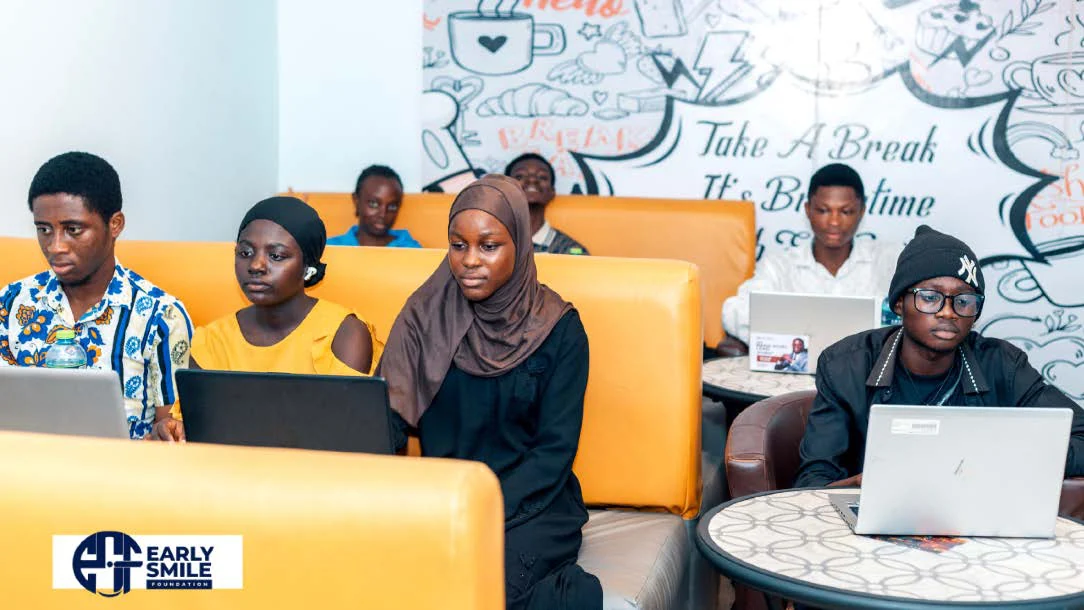
Project Kappa Cohort 1 participants working on laptops during a practical session.

01 / Why Kappa exists

Inspiration is
the beginning.

Young people need the opportunity to put what they learn into practice.

Project Kappa creates space to acquire practical skills, work alongside others and learn with experienced mentors. It connects technical learning with questions that matter in young people’s communities.

Our aim is to help young Africans become creators of solutions: curious enough to ask questions, confident enough to try and supported enough to keep learning.

Discover how it all began.
Portraits of all nine Project Kappa Cohort 1 participants — Early Smile Foundation.

02 / The 2026 pilot

Nine people.
A shared beginning.

Cohort 1 brought nine participants together for a six-week programme of practical programming, mentorship and collaborative project work.

Cohort participants
9
Programme length
6 weeks
Project teams
2

Mentor & facilitator

Tyrone Marghuy

Supporting the cohort’s programming and learning journey.

Get to know Tyrone

03 / The cohort experience

A journey
built together.

From the first application to the closing ceremony, the pilot connected learning, mentorship and collaboration.

  1. Applications

    The pilot received approximately 300 applications. Cohort 1 applications are now closed.

  2. Selection

    Nine participants formed the pilot cohort.

  3. Programming and Mentorship

    Participants developed practical programming skills with guidance from Tyrone Marghuy.

  4. Collaborative Project Development

    Two teams began developing technology-based concepts in response to challenges affecting young people.

  5. Closing Ceremony

    The first cohort came together to close its six-week programme.

04 / What participants worked on

Local challenges.
Ideas taking shape.

Two teams began exploring community-focused applications. Both projects are presented here as concepts in development.

Project Kappa Cohort 1 participants gathered around laptops in a group session.

Project A · Concept in development

Connection through
anonymous peer support.

An anonymous peer-support application focused on mental health. The team explored how technology could help young people connect and share with one another.

About the concept

The proposed application centres on anonymous peer-to-peer support. Work began during the pilot as participants applied their programming knowledge to a shared project idea.

Project B · Concept in development

A clearer view of
student accommodation.

A student accommodation rental platform with 3D property videos. The concept explores how students could view accommodation before choosing where to live.

About the concept

The proposed platform combines accommodation listings with 3D property videos. The team began developing the idea during the pilot’s collaborative project work.

05 / The ESF innovation pathway

Opportunity
passed forward.

Our long-term vision is a connected pathway: young people discover possibilities, develop their ideas and, over time, return to support the next generation.

ESF’s long-term vision

  1. Community Outreach

    First encounters with practical learning.

    Explore the Otinibi outreach
  2. I Too Can Do

    Relatable innovators and new possibilities.

    Explore the conversations
  3. Project Kappa

    Practical skills and collaborative experience.

  4. Mentorship

    Guidance as young people develop their ideas.

  5. Future African Innovators

    The ambition: young people creating solutions for their communities.

  6. Next Generation of Mentors

    The ambition: participants return to share their knowledge and experience.

06 / Outcomes & what’s next

A foundation
to build on.

The pilot gave participants experience in programming, teamwork and collaborative problem-solving. Two teams began developing ideas grounded in young people’s lives.

Learning by doing

Participants put new programming knowledge into practice through shared project work, with mentorship alongside technical learning.

Building a programme, too

The pilot highlighted the importance of access to laptops, a clear learning structure and sustained guidance as students develop their ideas.

Our approach to future cohorts

Our ambition is to help young people move from an initial question to an appropriate solution. These are guiding intentions for the programme’s development.

  1. Discover: understand problems around you.
  2. Understand: talk to people, investigate and validate the problem.
  3. Imagine: explore different possible solutions.
  4. Build: create the simplest useful prototype within your capacity.
  5. Test: put the solution in front of real users.
  6. Improve: learn from feedback and iterate.
  7. Present: communicate the solution, process and lessons learned.

Innovation can take many forms: software and digital products, physical prototypes, hardware and electronics, community solutions, services, process improvements or research-based proposals. These are possibilities for future work, not additional outcomes claimed for Cohort 1.

We aim to strengthen foundational learning, problem validation, regular progress reviews, mentor engagement and access to laptops and prototyping tools.

07 / Get involved

Bring what you know.
Help shape what’s next.

For mentors, universities, technology companies, foundations and supporters: help create the conditions for young people to learn and build.

Watch the film

Video playback loads only when you choose to watch.